


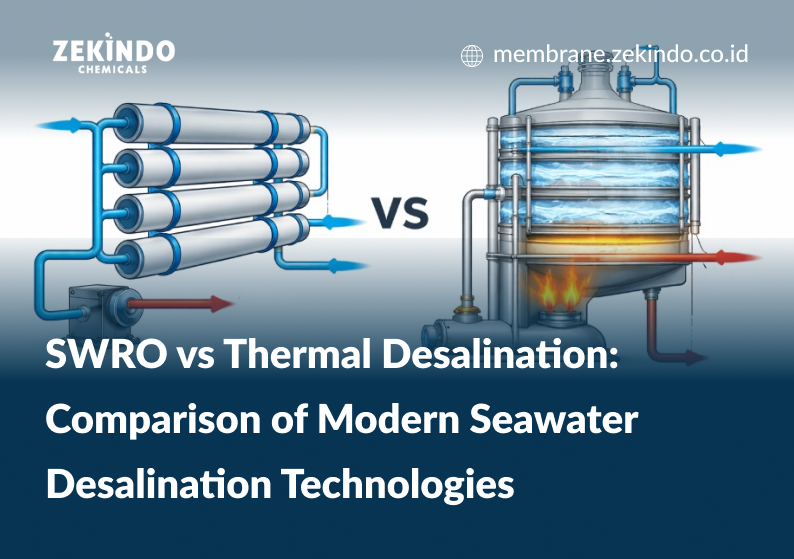
SWRO vs Thermal Desalination: Comparison of Modern Seawater Desalination Technologies
The availability of clean water has become one of the most significant challenges worldwide, particularly in coastal areas, remote islands, and regions with limited freshwater resources. One increasingly popular approach is seawater desalination, which refers to the process of converting seawater into water suitable for consumption.
Two main technologies dominate this field: SWRO (Sea Water Reverse Osmosis) and Thermal Desalination. Although both aim to achieve the same goal, their working principles are fundamentally different, and each offers unique advantages.
Understanding SWRO (Sea Water Reverse Osmosis)
Main SWRO Process:
- Pretreatment – Initial filtration to remove large particles, impurities, and microorganisms
- High-Pressure Pump – Provides the pressure required to push water through the membrane
- Membrane Separation – Separation of salt and clean water
- Post-treatment – Adjustment of pH and mineral content to ensure the water is safe for use
Advantages of SWRO:
- Lower energy consumption compared to thermal methods
- Relatively fast installation process
- Suitable for industrial use, hotels, and small communities
- More efficient investment and operational costs
- Modular design, making it easy to expand
Challenges of SWRO:
- Highly dependent on feed water quality
- Membranes require periodic replacement
- Requires an effective pretreatment system
- Risk of fouling (accumulation of contaminants on the membrane)
Understanding Thermal Desalination
Unlike SWRO, thermal desalination works by heating saline water until it evaporates and then condenses, turning the vapor into fresh water while leaving the salt behind. This process relies on the principle of thermal distillation and is typically categorized into main types such as MSF and MED.
Common Technologies Used:
- MSF (Multi-Stage Flash)
- MED (Multi-Effect Distillation)
- Vapor Compression (VC)
Main Thermal Process:
- Heating seawater to the evaporation point
- Condensing vapor into freshwater
- Multi-stage evaporation under varying pressures
- Collecting purified water
Advantages of Thermal Desalination:
- Produces very high-purity water with less complex post-treatment than SWRO
- Less sensitive to variations in seawater quality
- Stable for long-term operation
- Equipment generally has a longer lifespan
Challenges of Thermal Desalination:
- Very high energy consumption
- High capital investment
- Less flexible for small or remote applications
- Requires large-scale infrastructure
Key Factors to Consider
Choosing the right desalination technology should not be done arbitrarily. Important factors include:
- Energy availability: Thermal desalination is suitable when energy is inexpensive or readily available (e.g., from power plants)
- Water demand scale: SWRO is more flexible across different capacities
- Feed water conditions: High turbidity requires more complex pretreatment
- Long-term cost: SWRO is generally more economical
- Project location: Remote areas benefit from modular systems like SWRO
Current Trends in the Desalination Industry
In recent years, SWRO technology has advanced significantly, particularly in energy efficiency and membrane quality. Many new desalination projects worldwide now favor SWRO due to its cost-effectiveness and energy efficiency.
However, thermal desalination remains widely used in regions with abundant energy resources, such as the Middle East, especially for large-scale projects integrated with power plants.
The Right Desalination Solution for You
Every project presents unique challenges. With the right strategy, desalination technology can become a sustainable and efficient long-term investment.
Consult your water treatment needs with the ZEKINDO team to find the optimal, efficient, and sustainable filtration solution.
Learn more about membrane technology on the ZEKINDO website!