The filtration spectrum illustrates the range of water filtration technologies arranged according to the size of particles they can remove, from the coarsest to the finest filtration.
Each type of filtration media is specifically designed to target particular contaminants and impurities based on their size and properties. Therefore, in water filtration processes, the method used must be tailored to the type of contaminant that needs to be removed.
In general, as you move downstream in the filtration spectrum, the size of contaminants being removed becomes smaller, and the purity of the resulting water increases.
Filtration Spectrum & Type
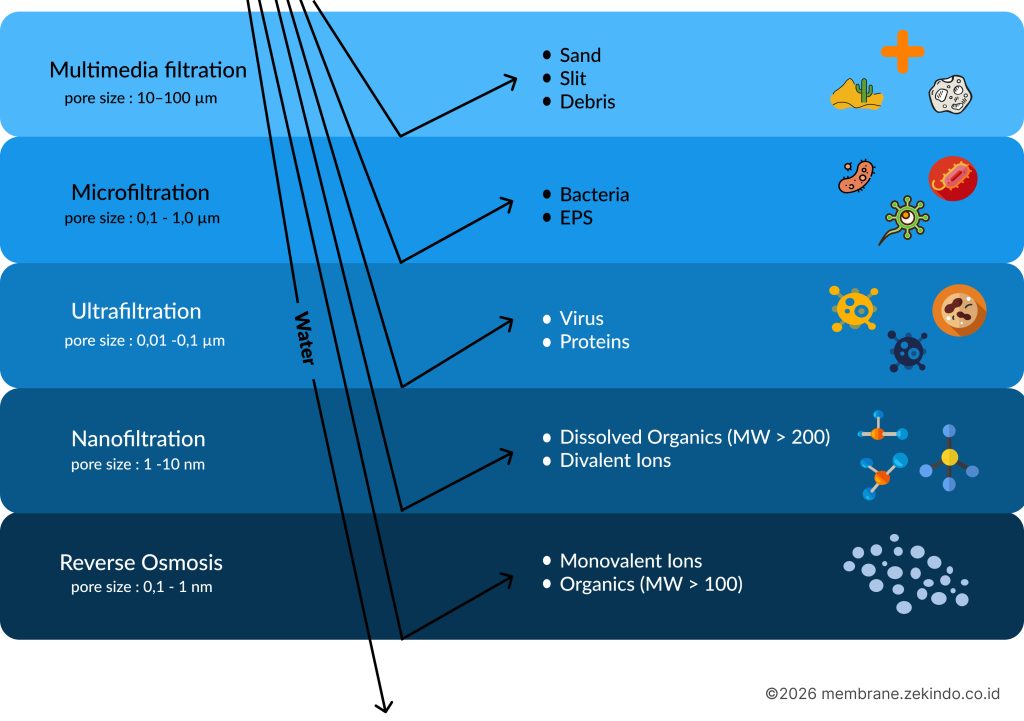
Multimedia Filtration (10–100 µm)
Multimedia filtration serves as the first line of defense in water treatment systems. This process utilizes layered filter media, including sand, gravel, and anthracite, to remove large particles.
Contaminants removed:
- Sand
- Silt
- Coarse sediment
- Solid debris
This stage plays a crucial role in protecting subsequent membranes from early fouling.
Microfiltration (MF) (0.01–0.1 µm)
Microfiltration is used to remove suspended particles and large microorganisms, thereby improving water clarity.
Contaminants removed:
- Suspended particles
- Fine sediment
- Bacteria
- EPS (Extracellular Polymeric Substances)
However, microfiltration is not capable of removing viruses or dissolved substances. This process is mainly effective for enhancing water clarity by removing sediment and bacteria.
Ultrafiltration (UF) (0.01–0.1 µm)
Ultrafiltration has smaller pore sizes compared to microfiltration and is used in applications that require higher water purity.
Contaminants removed:
- Viruses
- Proteins
- Colloids
- Large organic molecules
Ultrafiltration is commonly used in drinking water treatment as well as in the food and pharmaceutical industries.
Nanofiltration (NF) (1–10 nm)
Nanofiltration targets multivalent ions and dissolved organic compounds using ultra-fine membranes. These membranes are capable of filtering certain ions and small molecules.
Contaminants removed:
- Dissolved organic compounds with a molecular weight >200 Da
- Multivalent ions (Ca²⁺, Mg²⁺, SO₄²⁻)
Reverse Osmosis (RO) (0.1–1 nm)