


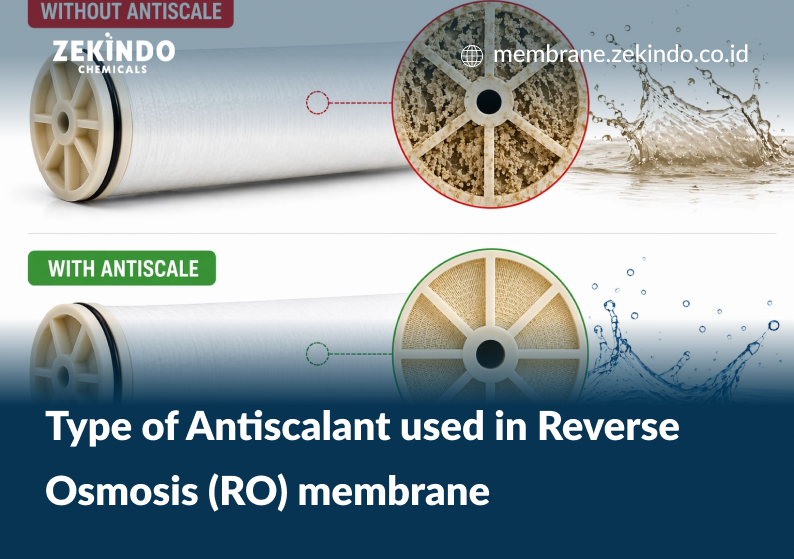
Type of Antiscalant used in Reverse Osmosis (RO) membrane
Antiscalant is a chemical used to prevent the formation of scale or crystallized salts. It is commonly applied in water purification systems, pipelines, and boilers. Scale formation occurs when the concentration of dissolved salts in water exceeds its solubility limit, resulting in solid deposits forming on surfaces. Antiscalants are designed to inhibit the formation of substances such as calcium, magnesium, and silica, which are the primary contributors to scaling. This chemical helps minimize deposit formation that can reduce equipment performance and operational efficiency.
Types of Scaling:
- Calcium Carbonate (CaCO₃)
Impact: Reduces heat transfer efficiency, leading to increased energy consumption and decreased system performance.
- Calcium Sulfate (CaSO₄)
Impact: Forms a very hard scale that is difficult to remove, causing performance decline and potential equipment damage.
- Silica (SiO₂)
Impact: Forms extremely hard, glass-like deposits that are difficult to clean even with acids, and can severely damage RO membranes and high-pressure boilers.
- Magnesium Hydroxide (Mg(OH)₂)
Impact: Causes fouling that disrupts water flow and reduces system efficiency.
- Iron Scale (Fe₂O₃ / Fe(OH)₃)
Impact: Clogs pipes and equipment while accelerating corrosion and overall system deterioration.
Applications:
In Reverse Osmosis (RO) membrane systems, antiscalants function to:
- Prevent mineral deposits and scale formation
They inhibit scaling caused by minerals such as calcium carbonate, calcium sulfate, magnesium sulfate, and silica in feed water.
- Maintain efficiency
They ensure stable water flow and prevent the performance decline of membranes.
- Extend membrane lifespan
By reducing physical damage from scaling and lowering the frequency of Cleaning in Place (CIP) processes.
How It Works:
Antiscalants operate through several mechanisms:
- Threshold inhibition
Prevents precipitation even at high mineral concentrations.
- Dispersion of particles
Keeps potential scale-forming minerals suspended in water so they are carried away with the flow.
- Crystal modification
Alters the crystal structure so deposits do not harden or adhere to surfaces easily.
Conclusion:
Antiscalant is a chemical that plays an important role in preventing scale formation caused by dissolved minerals such as calcium, magnesium, and silica in water treatment systems, especially Reverse Osmosis (RO) membranes. It helps maintain membrane performance by inhibiting crystal formation, keeping particles dispersed in water, and improving operational efficiency. As a result, antiscalants enhance system stability, improve water treatment efficiency, and extend membrane lifespan by reducing the risk of fouling.
The Right Solution for You
Optimize your system performance with the right antiscalant solution. Consult with us today.
Learn more about membranes on the ZEKINDO website!