Clean water is essential for modern life — from drinking water to high-tech industries. Among the many technologies available, Reverse Osmosis (RO) stands as the gold standard for removing dissolved impurities from water with unmatched efficiency.
Reverse Osmosis (RO) is a highly effective water purification technology that uses a semi-permeable membrane to remove dissolved salts, particles, and contaminants. By applying pressure greater than the natural osmotic pressure, water is forced through the membrane, leaving impurities behind in the reject stream.
Reverse osmosis is widely used in industries ranging from pharmaceuticals and food & beverage to seawater desalination and wastewater reuse.
Osmosis vs Reverse Osmosis
To grasp how RO works, it’s helpful to first understand osmosis, a natural process in biology.
- Osmosis is when water moves across a semi-permeable membrane from a region of low solute concentration to high solute concentration — aiming to equalize the concentrations on both sides.
Example: Plant roots absorbing water from soil.
- Reverse Osmosis, on the other hand, uses pressure to reverse this process. By applying high pressure to a more concentrated solution (such as seawater), we force water molecules through the membrane — leaving contaminants behind.
How Does Reverse Osmosis Work?
The RO process involves mechanical pressure, membranes, and crossflow filtration to purify water.
- Feed Water Input
Raw water (from wells, rivers, or seawater) enters the system. - High-Pressure Pump
A pump raises the pressure, overcoming natural osmotic pressure. - RO Membrane
Only water molecules pass through. Salts, minerals, bacteria, and other contaminants are rejected. - Separation into Two Streams:
- Permeate (Product Water) – Clean, purified water.
- Concentrate (Brine or Reject) – Wastewater containing removed contaminants.
Typical RO removal efficiency: 95–99% of dissolved salts and other impurities.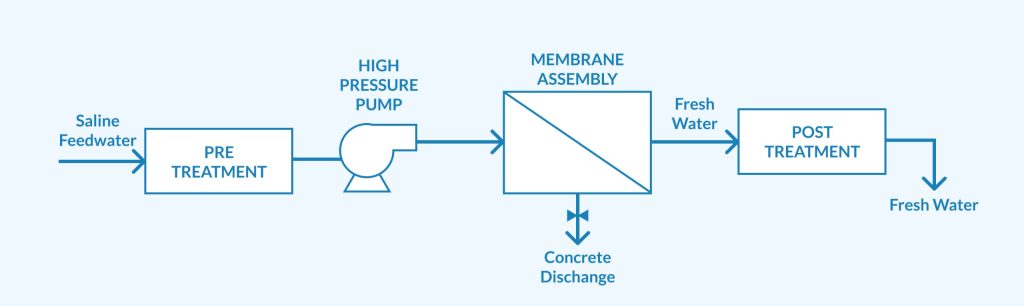
What Does RO Remove?
RO membranes remove a wide range of contaminants based on size and ionic charge:
Removed | Examples |
|---|
Salts & Minerals | Na⁺, Ca²⁺, Mg²⁺, Cl⁻ |
Heavy Metals | Arsenic, Lead, Mercury |
Organics & Microbes | Bacteria, Viruses, Pyrogens |
Particles | Sand, silt, rust |
Other | Nitrates, Fluoride, Sulfates |
RO is less effective at removing dissolved gases like CO₂, which may result in slightly acidic product water.
Benefits of Reverse Osmosis
Why do industries around the world choose RO systems for their water purification needs?
It’s because the benefits of reverse osmosis extend far beyond just clean water. Here are some of the most important advantages that make RO a go-to solution for various sectors:
- High Purity: Eliminates most impurities including salts and heavy metals.
- Cost-Effective: Lower energy consumption compared to thermal distillation or ion exchange.
- Eco-Friendly: No chemicals, less carbon footprint.
- Hardness Removal: Removes calcium and magnesium, reducing scaling risks.
Application of Reverse Osmosis
Reverse osmosis plays a vital role across many industries — from clean drinking water to high-tech manufacturing.
Here are some of the most common and impactful uses of RO technology:
- Desalination: Turning seawater into drinking water.
- Pharmaceutical: Creating sterile water for manufacturing.
- Food & Beverage: Producing consistent, high-quality ingredients.
- Electronics: Making ultrapure water for semiconductor production.
- Industrial Boilers: Providing clean feedwater for steam generation.
How ZEKINDO Supports Your RO Journey
At ZEKINDO, we don’t just deliver RO membranes — we offer complete reverse osmosis solutions tailored for industrial, municipal, and commercial needs.
Whether you’re:
- Designing a new system
- Retrofitting an existing one
- Needing membrane replacements or chemical treatment
Our technical team ensures your system is designed efficiently, maintained proactively, and operated optimally.
Explore our Reverse Osmosis product line on our website!


